
Supply Chain Risk
Introduction
Every business that runs on paper—offices, print shops, retailers, hospitals, and schools depends on one uninterrupted flow: paper reaching the shelf or the printer tray on schedule. Even a short disruption can create unnecessary supply chain risk, affecting productivity, customer service, and day-to-day operations. Most procurement teams compare suppliers based on price per ream, but price is the easiest variable to negotiate and often the least likely factor to determine whether your business experiences costly supply interruptions.
What causes real damage is supply chain risk: the mill that stops shipping, the customs delay that strands a container, the supplier who quietly substitutes your branded order with an unlabeled equivalent. These risks almost never show up in a quote. They show up three months later, when your invoicing system runs out of thermal rolls or your print shop can’t fulfill a client order on deadline.
This article breaks down the risk factors hidden inside paper sourcing the ones a spreadsheet comparison won’t catch and gives you a practical framework for vetting any paper products supplier before you sign a contract. Whether you buy office copy paper by the pallet or industrial paper by the container, the goal is the same: continuity you can plan around, not a gamble you find out about later.
Why Supply Chain Risk Should Drive Your Supplier Choice
Paper feels like a commodity, which is exactly why it’s risky to shop it like one. A commodity mindset says “any A4 ream will do” but underneath identical-looking packaging, GSM weight, brightness, opacity, moisture content, and finishing quality can vary from batch to batch and mill to mill. A supplier who can’t control that variation passes the instability straight to you: printer jams, inconsistent print output, inventory that technically matches the spec sheet but not the last shipment you received.
Then there’s continuity. A single-source supplier relying on one mill and one shipping lane is one customs delay away from leaving you empty-handed. Multiply that across dozens of SKUs and multiple warehouses, and a vendor problem becomes an operational problem for your whole business. For distributors and wholesalers, it becomes a reputational problem with their own downstream customers.
The right supplier isn’t the one with the lowest quote it’s the one whose sourcing, certification, and logistics are transparent enough that you can actually forecast around them. That transparency, more than price, is what separates a vendor from a partner.
12 Factors That Reduce Supply Chain Risk in Paper Sourcing
1. Sourcing transparency branded vs. private-label honesty
Many “branded” paper listings online are actually private-label or generic stock dressed up with a recognizable name nearby. Ask directly: is this SKU manufactured by the brand named on the packaging, or is it a generic equivalent? A supplier who volunteers this distinction rather than blurring it is signaling they understand where liability sits if a batch underperforms.
2. Certification verification
FSC, PEFC, and ISO certifications are frequently listed as blanket claims on a supplier’s “About” page rather than tied to specific product lines. Certifications should be verifiable at the SKU level, not just the company level. If a supplier can’t produce documentation for the specific product you’re ordering, treat the certification as marketing copy, not a guarantee.
3. Batch-to-batch consistency
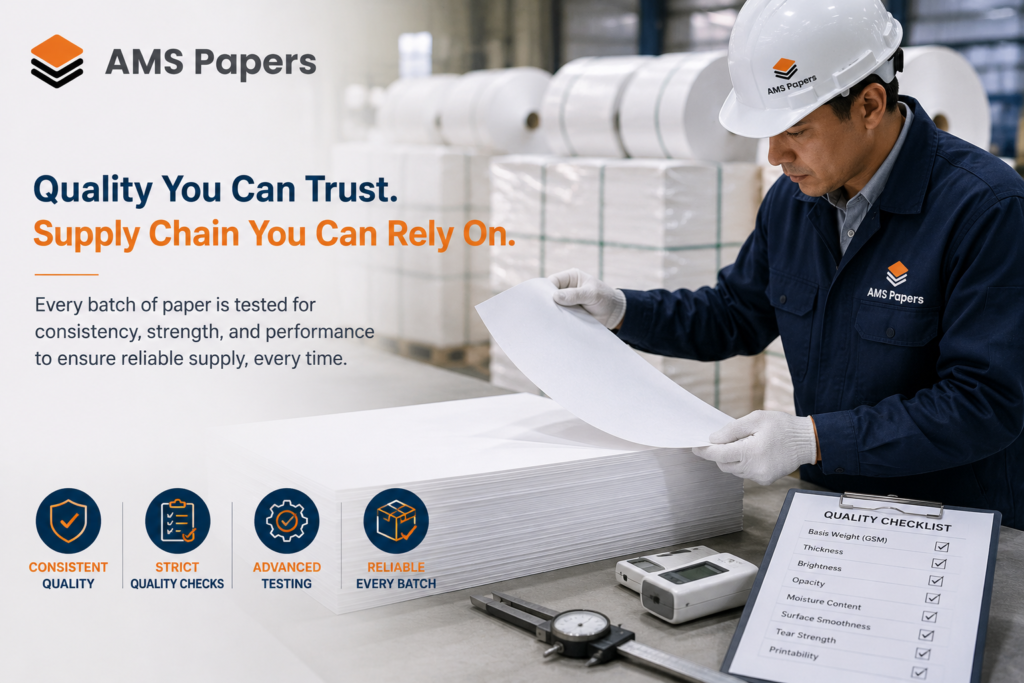
Ask how quality control is performed between production runs not just at the factory, but at receiving. Paper that tests fine on a spec sheet can still vary in opacity or finish between shipments in ways that affect print quality or machine compatibility. Suppliers with documented QC checkpoints catch this before it reaches you.
4. Mill and manufacturing diversification
A supplier dependent on a single mill or single country of origin carries their sourcing risk directly into your business. Ask whether alternate manufacturing sources exist for your product line, and what the actual failover process looks like if the primary source is disrupted.
5. Inventory buffer and warehousing capacity
Suppliers operating on just-in-time stock with no buffer are fragile by design. Ask what safety stock they hold for your product category and how they’ve handled demand spikes or shipping delays in the past. A supplier without a clear answer here is one disruption away from an empty warehouse.
6. Logistics reliability across regions
If you operate across multiple markets, ask about actual delivery lead times by region, not headline claims of “international supply.” A supplier serving Europe and the Americas should be able to give you real transit windows and contingency routes, not just a list of continents they ship to.
7. Order flexibility
Minimum order quantities that don’t match your actual consumption pattern create their own risk either overstock tying up cash and warehouse space, or under-ordering that forces rush reorders. Look for suppliers who can structure order sizes, mixed pallets, and reorder cadence around your real usage, not their preferred batch size.
8. Communication and account responsiveness will reduce supply chain risk
Supply risk isn’t only about physical stock it’s also about how fast you find out something has gone wrong. A supplier who is slow to respond during a normal sales inquiry will be slower still during an actual disruption. Test responsiveness before you commit volume, not after.
9. Financial stability and business longevity
A supplier’s ability to hold pricing, absorb short-term cost shocks, and maintain production depends on their own financial footing. Longevity in the market is one of the more reliable (if imperfect) signals here a supplier that’s weathered previous raw material or shipping cost spikes has a track record worth checking.
10. Pricing transparency and contract terms
Ask what happens contractually if a shipment is delayed, short, or substituted. Vague or verbal-only agreements around these scenarios are a red flag. Clear terms on substitutions, delay penalties, and pricing locks protect you from absorbing a supplier’s operational problems as your own cost.
11. Regulatory and customs compliance by destination market
Paper products crossing borders are subject to import documentation, labeling, and sometimes tariff classifications that vary by destination. A supplier experienced in your specific import market reduces the risk of customs holds a common and underestimated source of stockouts.
12. Sustainability practices as an operational signal, not just marketing
Genuine sustainability practices reduced water use, renewable energy in production, recycling programs often correlate with more disciplined, better-documented operations overall. Treat sustainability claims as one data point in assessing operational maturity, not just an environmental checkbox.
Common Mistakes That Increase Supply Chain Risk
Buying purely on price per ream. The cheapest quote often hides the highest downstream risk inconsistent quality, slower replenishment, or unverified certifications. Price should be one input in a weighted decision, not the deciding one.
Single-sourcing everything. Relying on one supplier for an entire product category means one disruption stops your whole operation. Even a modest secondary source, used occasionally, keeps your primary supplier honest and gives you a tested fallback.
Taking certification claims at face value. “FSC certified” on a homepage isn’t the same as a certificate tied to the SKU you’re ordering. Always ask for documentation specific to your order.
Assuming “wholesale” implies quality control. Bulk pricing and quality assurance are two separate things. Some wholesale suppliers optimize purely for volume and margin, with inconsistent QC between shipments.
Skipping the sample stage. Ordering a full pallet or container based on a spec sheet alone, without testing a sample batch first, is one of the most common and most avoidable sources of costly surprises.
Ignoring contract language around delays and substitutions. Verbal assurances don’t hold up when a shipment is late or short. Get delay, substitution, and pricing-lock terms in writing before placing a recurring order.
Questions That Reveal Hidden Supply Chain Risk
Before committing to a new paper supplier or renewing with an existing one get direct answers to these:
- Can you provide certification documentation (FSC/PEFC/ISO) specific to this exact product, not just the company overall?
- Is this product manufactured by the named brand, or is it a private-label equivalent?
- What is your standard lead time to my region, and what’s your contingency if that timeline slips?
- Do you hold safety stock for this product, and how much?
- What happens contractually if a shipment arrives short, delayed, or substituted with a different product?
- Can I get a sample batch before committing to a bulk or container order?
- Do you source this product from a single mill, or do you have alternate manufacturing sources?
- What is your minimum order quantity, and can order size flex with my actual usage pattern?
- Who is my direct point of contact if something goes wrong after the order ships?
- How long has your company operated in this specific product category?
A supplier who answers these clearly and specifically is showing you how they’ll behave during a disruption — not just during a sales conversation.
Why AMS Papers Reduces Supply Chain Risk
AMS Papers has supplied copy and printing paper, thermal paper, industrial and packaging paper, tissue products, and wholesale paper solutions to businesses across Europe, the Americas, and international markets since 2008. Our product catalog is built on a clear, disclosed distinction between verified branded products including Navigator, PaperOne, Double A, Xerox Premier, Reflex, Rotatrim, and JK Copier and generic or private-label stock, so buyers know exactly what they’re ordering and what certifications actually apply.
We support both wholesale distributors and businesses with more moderate volume needs, with order structures designed around real consumption patterns rather than a one-size batch size. Our sourcing spans multiple product categories and manufacturing relationships, reducing single-point failure risk for recurring orders. For businesses that depend on predictable paper supply offices, print operations, retailers, and distributors our focus is on giving you the documentation, consistency, and responsiveness that make forecasting possible.
Conclusion
Choosing a paper products supplier is rarely about finding the lowest price it’s about finding the supplier whose sourcing, certification, and logistics you can actually verify and plan around. The businesses that get burned aren’t the ones who paid slightly more; they’re the ones who didn’t ask the right questions before the order shipped. Use the factors and questions above as a working checklist the next time you evaluate a current or prospective supplier, and treat transparency not just price as your primary filter. A reliable paper supply chain isn’t luck. It’s the result of vetting the right things before you commit.
FAQ
What is supply chain risk in paper sourcing? It’s the risk that a disruption anywhere in your supplier’s sourcing, manufacturing, or logistics chain a mill shortage, a shipping delay, a customs hold interrupts your own paper supply, regardless of what your contract or price agreement says on paper.
How can I verify a supplier’s certifications are genuine? Ask for certification documentation tied to the specific product SKU you’re ordering, not a general company-level claim. Certification bodies like FSC and PEFC maintain searchable registries you can cross-check independently.
Is it better to work with one supplier or several? For most businesses, a primary supplier with a qualified secondary source is safer than relying on either a single supplier or too many fragmented relationships. A secondary source doesn’t need to carry regular volume it exists so you have a tested fallback if your primary supplier is disrupted.
Does buying wholesale automatically reduce risk? No. Wholesale pricing addresses cost, not necessarily consistency or continuity. A wholesale supplier without strong QC and inventory buffering can still expose you to the same batch-variation and stockout risks as a smaller supplier.
What’s the difference between branded and private-label paper, and does it matter? Branded paper is manufactured and certified under a recognized name (e.g., Navigator, PaperOne). Private-label or generic paper may perform comparably but shouldn’t carry certification or brand claims that don’t apply to it. It matters because certification claims affect your own compliance if you resell or use the product commercially.
How often should I re-evaluate my paper supplier? An annual review is reasonable for most businesses, with an additional check whenever you notice inconsistent quality, missed delivery windows, or unexplained price changes all early signals of supplier-side instability.
What should I do if my current supplier can’t answer these questions confidently? Treat it as a signal, not necessarily a dealbreaker. Request documentation in writing, set a timeline for them to respond, and begin qualifying a secondary supplier in parallel so you’re not exposed while you wait.