
This guide breaks down US paper weight vs GSM comparisons in full: why two different measurement systems exist, how to convert accurately between them, where buyers most often get it wrong, and how to specify paper correctly when your business operates across US and international suppliers. Whether you’re a procurement manager standardizing paper across regional offices, a print shop quoting a job from an overseas client’s spec sheet, or a distributor trying to match an equivalent product, this is the reference built to answer it completely.
Why US Paper Weight and GSM Are Different Systems
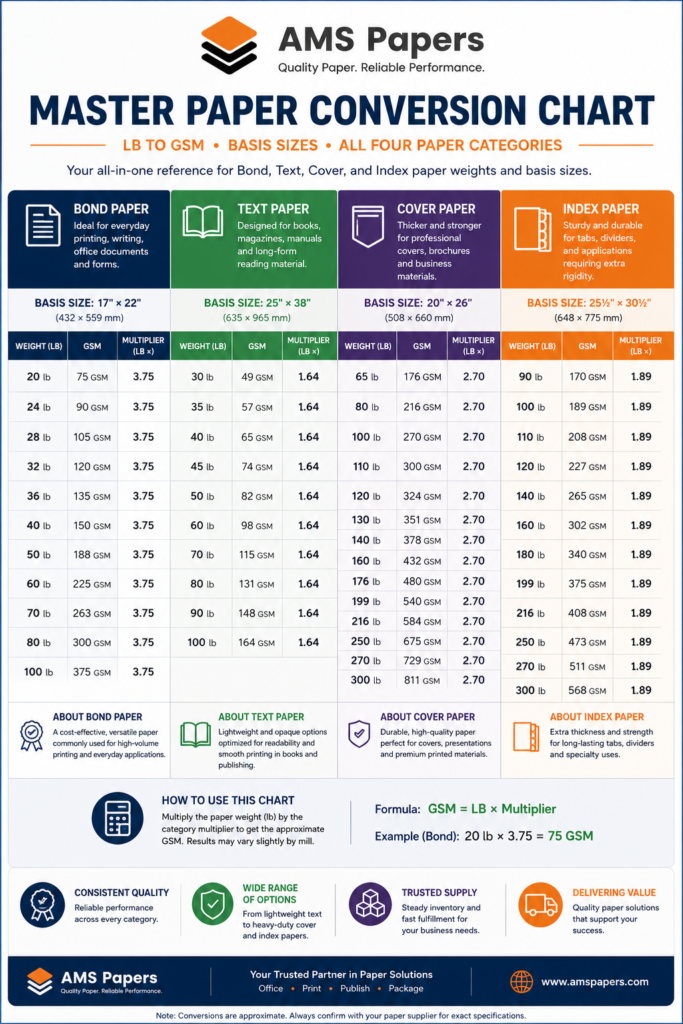
The core reason US paper weight vs GSM comparisons are confusing is that they’re not measuring paper the same way. GSM (grams per square meter) is a direct, absolute measurement one square meter of the sheet, weighed in grams, full stop. It doesn’t matter what kind of paper it is; the number always means the same thing, which is why GSM is the standard under ISO 536 and used across most of the world.
US paper weight, often called basis weight, measures something different: the weight, in pounds, of a ream (500 sheets) of paper cut to that paper category’s specific “basis size” a standardized sheet size that varies depending on whether the paper is bond, text, cover, or index stock. This is the detail almost every basis-weight explainer skips, and it’s the entire reason the same number (“20 lb,” for example) can refer to genuinely different papers depending on category.
The Basis Size Problem
Each US paper category has its own basis size, inherited from historical printing trade conventions:
- Bond/Writing paper: basis size 17″ × 22″
- Text/Book paper: basis size 25″ × 38″
- Cover stock: basis size 20″ × 26″
- Index stock: basis size 25.5″ × 30.5″
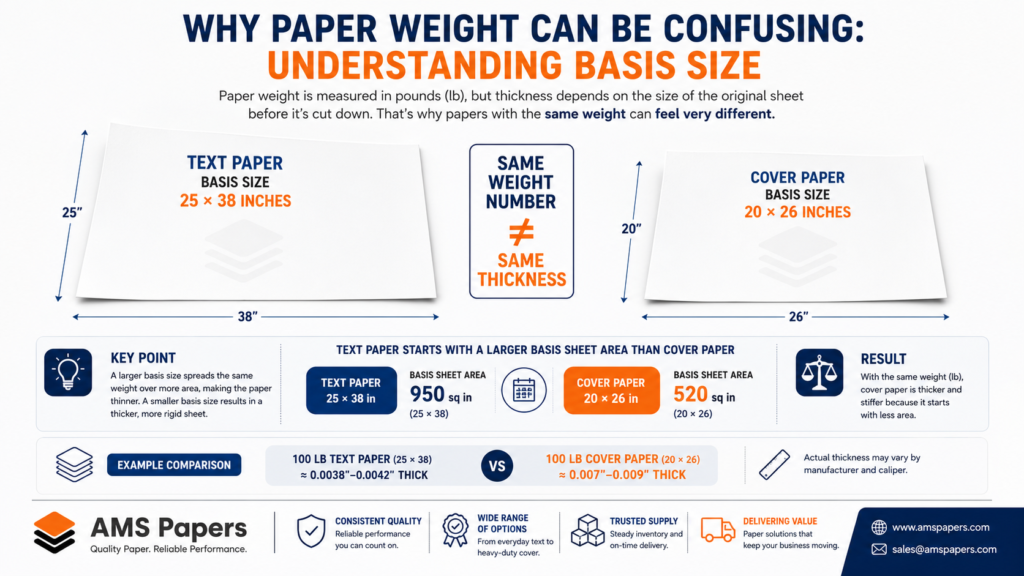
Because a ream of each category is a different physical size before it’s cut down to a final product, the same basis weight number in two different categories represents a different actual sheet weight and thickness. This is precisely why “20 lb bond” and “20 lb text” are not remotely similar in thickness a fact that trips up even experienced buyers moving between paper categories for the first time.
US Paper Weight vs GSM: The Conversion Formulas
Because GSM is an absolute measurement and US basis weight is category-dependent, converting between them requires a different multiplier for each paper category, based on the internationally recognized Paper and Board, Determination of Grammage. These multipliers are derived directly from each category’s basis size and are consistent with standard industry references, such as the basis weight conversion chart published by Mohawk Paper
| Paper Category | Basis Size | lb → GSM Multiplier | GSM → lb Multiplier |
|---|---|---|---|
| Bond/Writing | 17″ × 22″ | × 3.76 | ÷ 3.76 |
| Text/Book | 25″ × 38″ | × 1.48 | ÷ 1.48 |
| Cover | 20″ × 26″ | × 2.70 | ÷ 2.70 |
| Index | 25.5″ × 30.5″ | × 1.81 | ÷ 1.81 |
Example conversion: to convert 24 lb bond to GSM, multiply 24 × 3.76 = 90 GSM. To convert 100 GSM cover stock back to US basis weight, divide 100 ÷ 2.70 ≈ 37 lb though in practice, cover stock is rarely specified this thin, which is a useful sanity check that you’re using the right category’s multiplier.
Bond Paper Weight to GSM Comparison Chart
Bond (also called writing or copy paper weight) is the category most office buyers deal with daily. Here’s how common bond weights convert:
| US Bond Weight (lb) | GSM Equivalent | Typical Use |
|---|---|---|
| 16 lb | 60 GSM | Lightweight drafts, carbonless forms |
| 20 lb | 75 GSM | Standard copy paper weight, everyday office printing |
| 24 lb | 90 GSM | Premium copy paper, presentations, resumes |
| 28 lb | 105 GSM | Heavy-duty office documents, brochures |
| 32 lb | 120 GSM | Premium presentation and marketing materials |
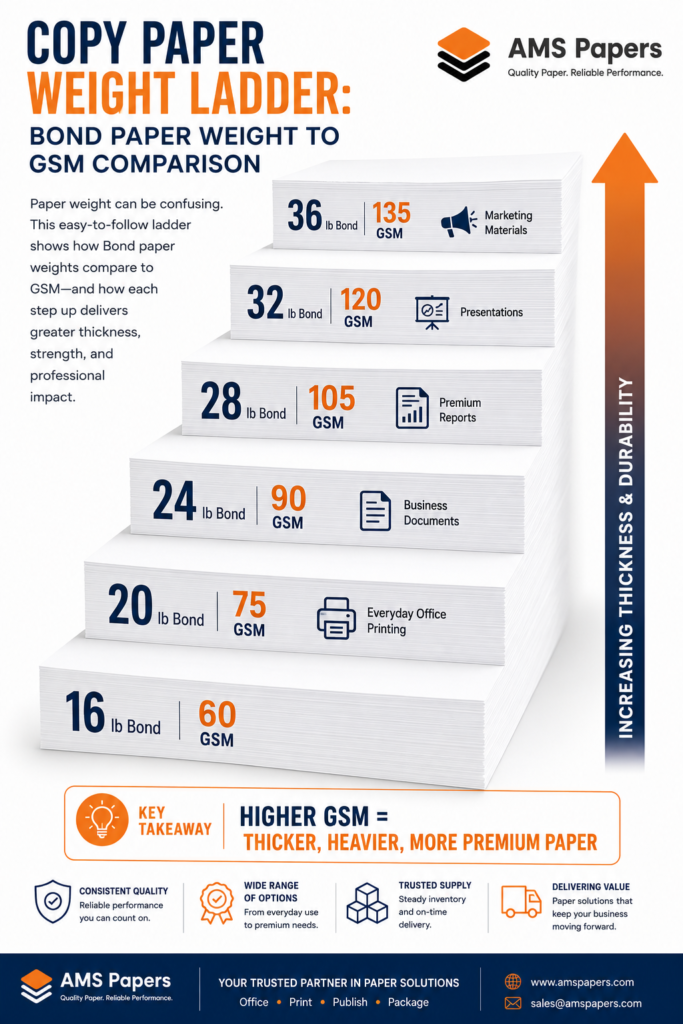
This chart is the one most procurement teams actually need, since it covers the copy paper weight range used in the overwhelming majority of office and business printing.
Text Weight vs. Cover Weight: A Critical Distinction
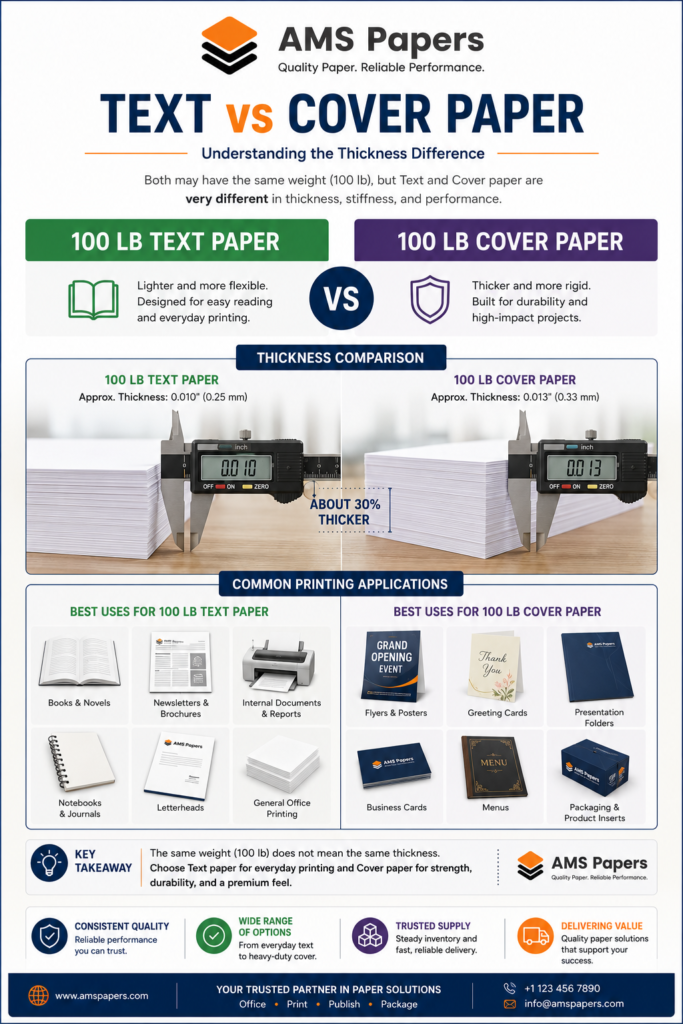
One of the most common mistakes in US paper weight vs GSM conversions is confusing text weight with cover weight two categories that use completely different multipliers and represent very different actual paper thickness, despite sometimes carrying similar-looking basis weight numbers.
Text weight paper is used for the body pages of books, brochures, and multi-page documents thinner and more flexible than cover stock, even at a seemingly “heavier” basis weight number. Cover weight paper (the source of the term cardstock weight in casual use) is genuinely thick, rigid stock used for postcards, business cards, book covers, and packaging.
| Term | Basis Size | Typical Weight Range | Feel |
|---|---|---|---|
| Text weight | 25″ × 38″ | 50–100 lb (74–148 GSM) | Flexible, book-page-like |
| Cover weight | 20″ × 26″ | 60–130 lb (162–350 GSM) | Rigid, cardstock-like |
The critical buying mistake: a “100 lb text” sheet (148 GSM) is noticeably thinner and more flexible than an “80 lb cover” sheet (216 GSM), even though the raw basis weight number is higher for the text sheet. If you only compare the lb numbers without knowing the category, you’ll assume the opposite of what’s actually true this single confusion is responsible for more paper ordering mistakes than almost any other factor in US paper weight vs GSM conversions.
Cardstock Weight (Cover Stock) to GSM Comparison Chart
| US Cover Weight (lb) | GSM Equivalent | Typical Use |
|---|---|---|
| 65 lb | 176 GSM | Postcards, light cardstock, flyers |
| 80 lb | 216 GSM | Business cards, greeting cards |
| 100 lb | 270 GSM | Premium business cards, folders |
| 110 lb | 297 GSM | Heavy cardstock, packaging inserts |
Paper Thickness: Why Weight Isn’t the Whole Story
Paper weight and paper thickness are related but not identical a distinction that matters once you’re deep into US paper weight vs GSM comparisons. Thickness (technically called caliper) is measured independently in thousandths of an inch (mils) or in “points” in the printing trade, and two papers with the same GSM can have slightly different caliper depending on how densely the fibers are pressed during manufacturing.
In practice, GSM and caliper track closely enough for most buying decisions heavier GSM almost always means thicker paper — but if a print job specifies an exact caliper (common in packaging and specialty printing), basis weight or GSM alone won’t guarantee a match. Caliper is measured according to standardized test methods published by Technical Association of the Pulp and Paper Industry; when caliper matters, ask your supplier for the specific point/mil measurement rather than relying on weight conversion alone.
Paper Weight Chart: Quick Reference Across All Common Categories
| Category | Common Weight (lb) | GSM Equivalent | Everyday Example |
|---|---|---|---|
| Bond | 20 lb | 75 GSM | Standard copy paper |
| Bond | 24 lb | 90 GSM | Premium copy paper |
| Text | 60 lb | 89 GSM | Booklet interior pages |
| Text | 80 lb | 118 GSM | Brochure body pages |
| Cover | 65 lb | 176 GSM | Postcards |
| Cover | 100 lb | 270 GSM | Business cards |
| Index | 90 lb | 163 GSM | Index cards, tags |
| Index | 110 lb | 199 GSM | Heavy index stock |
Printing Paper GSM: What Printer Manufacturers Actually Specify
Printer compatibility is one of the most practical reasons to get US paper weight vs GSM conversions right. Printer manufacturers publish supported paper weight ranges in GSM (or sometimes both units) in their technical documentation — checking the manufacturer’s specification for your exact model is more reliable than assuming a “standard” range, since supported weights vary meaningfully between consumer, business, and production-class devices. Printer Paper Weight Specifications, Media Compatibility Guide, and Paper and Media Specifications each publish this information in their printer and multifunction device specification sheets, and it’s worth checking directly rather than assuming compatibility based on general copy paper weight norms.
Common Mistakes When Converting US Paper Weight vs GSM
Applying the bond multiplier to every paper category. This is the single most common error using the 3.76 bond conversion factor on a text-weight or cover-weight spec sheet produces a number that looks plausible but is wrong, sometimes by a large margin.
Assuming “heavier number” always means “thicker paper” across categories. As covered above, a higher text-weight number can represent thinner paper than a lower cover-weight number.
Ignoring the difference between basis weight and actual sheet weight after trimming. Basis weight is calculated on the untrimmed basis size, not the final cut sheet for standard letter or A4-cut paper this rarely matters, but it’s a relevant distinction for custom-cut stock.
Treating GSM and caliper (thickness) as always interchangeable. Useful as a rule of thumb, but not guaranteed for every manufacturing process, as covered above.
Failing to specify category when requesting a quote across regions. Asking an international supplier to match “24 lb paper” without specifying bond, text, or cover invites a mismatched quote, since the number alone is ambiguous outside its category context.
Practical Buying Advice for Procurement Managers and Distributors
If your business sources paper across both US and GSM-standard regions, standardize on GSM internally wherever possible, even for US-based teams it removes the basis-size ambiguity entirely and simplifies comparing quotes from different suppliers. When a US-based spec sheet only lists lb weight, always confirm the paper category (bond, text, cover, or index) before converting, rather than assuming bond by default. For copy paper weight specifically, 20 lb (75 GSM) covers the overwhelming majority of standard office use, while 24 lb (90 GSM) is the common step up for premium documents and presentations this single distinction resolves most everyday office paper ordering decisions without needing the full conversion chart.
When working with a Copy Paper Supplier, ask them to confirm both measurements on any quote or spec sheet a supplier that can readily provide both lb and GSM figures, tied to the correct paper category, is a strong signal of genuine sourcing transparency rather than a generic, uncertain conversion.
Expert Tips for Getting US Paper Weight vs GSM Right Every Time
- Always confirm the paper category before converting bond, text, cover, and index each use a different multiplier, and the category is often more important than the number itself.
- When in doubt, request GSM directly from any supplier, regardless of which country they’re based in most international manufacturers can provide it even if their default sheet lists lb weight.
- Keep a physical reference: request paper swatch samples at a few common weights (20 lb/75 GSM, 24 lb/90 GSM, 32 lb/120 GSM) to build an intuitive feel for the numbers rather than relying on charts alone.
- For anything beyond everyday copy paper weight packaging, specialty print jobs, or anything with a tight tolerance ask for caliper/point thickness alongside weight, since weight alone won’t guarantee dimensional consistency.
- If you regularly compare products across Paper Sizes as well as weight, remember size and weight are independent specifications matching one doesn’t guarantee the other matches too.
Frequently Asked Questions
What is US paper weight vs GSM, in simple terms? US paper weight (basis weight) measures the weight in pounds of a ream cut to a category-specific basis size, while GSM measures the weight in grams of one square meter directly, regardless of category. The same GSM figure means the same thing everywhere; the same lb figure depends on which paper category it belongs to.
How do I convert 20 lb bond paper to GSM? Multiply by 3.76: 20 lb bond × 3.76 ≈ 75 GSM, which is the standard weight for everyday copy paper.
Is 24 lb paper the same as 90 GSM? Yes, for bond/writing paper specifically: 24 lb bond converts to approximately 90 GSM. The same “24 lb” figure would convert differently if it referred to text or cover stock instead.
What GSM is standard copy paper weight? Standard copy paper is typically 75–90 GSM (20–24 lb bond), with 75 GSM/20 lb being the most common default for everyday office printing.
What’s the difference between text weight and cover weight? Text weight paper is thinner, flexible stock used for book and brochure interior pages; cover weight (cardstock weight) is thicker, rigid stock used for covers, business cards, and packaging. They use different basis sizes and different lb-to-GSM multipliers, so identical-looking lb numbers don’t represent similar thickness across the two categories.
What is basis weight? Basis weight is the US measurement system for paper weight the weight, in pounds, of a ream (500 sheets) cut to a specific category’s standardized basis size (bond, text, cover, or index each have their own).
Does paper weight always match paper thickness? Generally yes heavier GSM or basis weight typically means thicker paper but not perfectly in every case, since manufacturing processes can affect caliper (thickness) independently of weight. For exact thickness requirements, request caliper measurements directly.
What GSM is considered cardstock weight? Cardstock generally starts around 176 GSM (65 lb cover) and can go up to 300+ GSM (110+ lb cover) for heavier applications like packaging inserts and premium business cards.
How do I know which basis weight multiplier to use? Identify the paper category first bond, text, cover, or index since each has its own basis size and multiplier. If the category isn’t specified on a spec sheet, ask the supplier directly before converting, since assuming the wrong category is the most common source of conversion errors.
Why doesn’t the US use GSM like most other countries? The US paper industry’s basis weight system predates the international adoption of the metric-based GSM standard and has remained the trade convention domestically, even as most manufacturing and printing internationally standardized on GSM under ISO 536.
Can I ask an international paper supplier for lb weight instead of GSM? Yes most manufacturers serving multiple markets can convert and quote in either system, but it’s worth confirming the paper category (bond, text, cover) explicitly in the request to avoid ambiguity, particularly if you need a A4 Copy Paper Guide to standardize sourcing across US and international offices.
Conclusion
US paper weight vs GSM isn’t a single conversion it’s a small set of category-specific conversions that depend entirely on knowing whether you’re working with bond, text, cover, or index stock. Get the category right, and the math is simple and reliable; skip that step, and even a correct-looking conversion can be meaningfully wrong. For procurement teams and distributors operating across regions, the safest long-term approach is standardizing internally on GSM wherever practical, and treating US basis weight as a conversion to check against, rather than a primary spec to build purchasing decisions around.
If your business sources paper across both US and international markets, working with a supplier who can confirm both measurements accurately and explain which paper category a spec sheet is actually referring to removes this entire category of ordering error before it happens. Copy Paper Supplier teams that handle this correctly as a matter of course are worth prioritizing over ones that simply supply a single, unverified conversion number.