
What Does “Wholesale Paper” Actually Mean? MOQs, Pricing Tiers, and When It Makes Sense
Wholesale paper is one of those terms everyone uses and almost no one defines. Ask five suppliers what makes an order “wholesale” and you’ll likely get five different answers some tied to volume, some tied to who’s buying, some just tied to a discount code on a website. That vagueness costs buyers money, because without knowing what actually drives wholesale paper pricing, it’s nearly impossible to know whether a quote is genuinely good or just labeled that way.
This guide breaks wholesale paper down properly: what the term actually means, how minimum order quantities (MOQs) are set and why, how pricing tiers really work behind the scenes, and most usefully when buying wholesale paper makes sense for your business and when it doesn’t. Whether you’re ordering your first bulk shipment of copy paper or trying to figure out why one supplier’s “wholesale” pricing looks nothing like another’s, this is the reference built to answer it completely. If you’re ready to compare options directly, you can also browse current Wholesale Paper Supply Category listings alongside this guide.
What Does “Wholesale Paper” Actually Mean?
At its core, wholesale paper refers to paper sold in bulk quantities, typically at a lower per-unit cost than retail pricing, usually to businesses rather than individual consumers. But that definition only tells you what wholesale paper isn’t retail, small-batch, one-off. It doesn’t tell you what actually determines whether a specific quote qualifies as genuinely wholesale pricing or just a modest volume discount wearing a wholesale label.
In practice, wholesale paper pricing is driven by three factors working together:
- Production economics how paper mills and converters actually manufacture and package paper
- Order volume relative to a supplier’s standard unit pallet, case, or container-level thresholds
- Distribution efficiency how much handling, storage, and shipping cost the supplier saves by fulfilling a larger, less-fragmented order
Understanding these three drivers is the difference between evaluating a wholesale paper quote intelligently and just trusting the label on the page.
Wholesale vs. Retail Paper: The Real Difference
Retail paper pricing is built around convenience small quantities, flexible order sizes, immediate availability, often through a marketplace or storefront with built-in margin to cover that flexibility. Wholesale paper pricing removes most of that flexibility in exchange for a lower per-unit cost, because the supplier’s own costs (picking, packing, per-order handling, marketing overhead) drop significantly when volume goes up and order frequency goes down.
This is the part many buyers miss: wholesale isn’t just “the same paper, cheaper.” It’s a different transaction structure larger commitment, longer lead times in some cases, less flexibility on order size in exchange for meaningfully better unit economics.
What Is MOQ in Wholesale Paper?
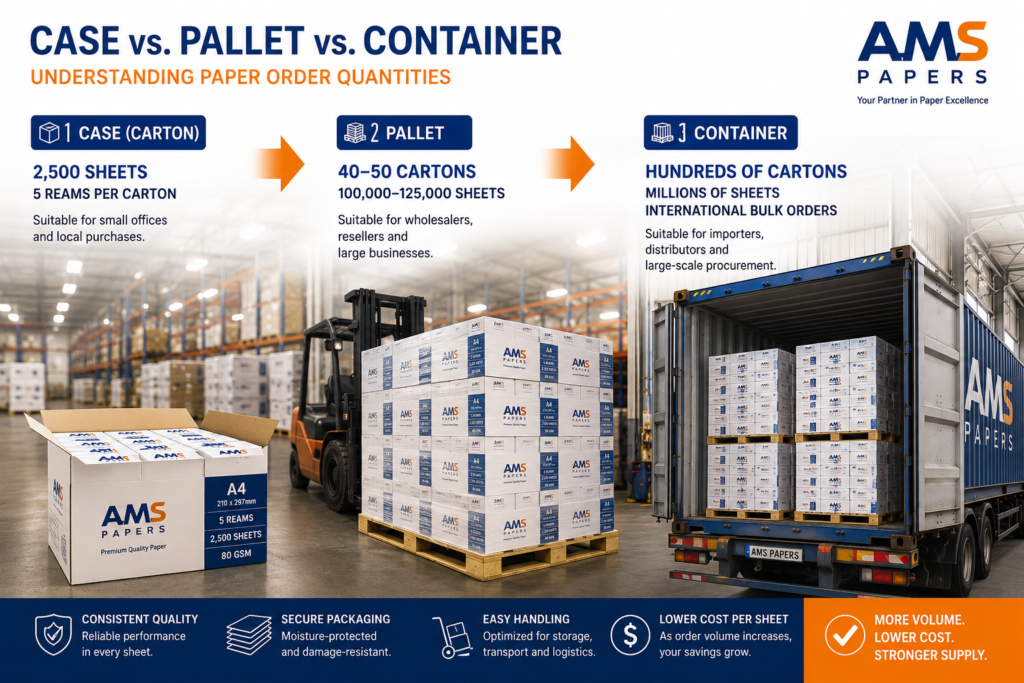
MOQ stands for minimum order quantity the smallest amount of product a supplier is willing to sell in a single order, below which they either won’t fulfill the order at all or will only fulfill it at standard (non-wholesale) pricing. For paper specifically, MOQs typically map to one of three physical units:
- Case-level MOQ a set number of reams boxed together, common for smaller-volume wholesale entry points
- Pallet-level MOQ a full pallet of cases, the most common wholesale threshold for copy and printing paper
- Container-level MOQ a full shipping container, typically reserved for the largest distributors and importers
Why MOQs Exist in the First Place
MOQs aren’t an arbitrary gatekeeping tactic they exist because of genuine production and logistics economics. Paper mills run production in large batches for efficiency; breaking a production run into smaller units to serve small orders adds cost at every step, from converting (cutting large rolls into ream-sized sheets) to packaging to warehousing to shipping. A supplier quoting below their actual MOQ threshold is either absorbing a loss on that order or quietly reducing quality/service to compensate neither of which serves the buyer well in the long run.
Typical MOQ Ranges by Paper Category
| Paper Category | Typical Case MOQ | Typical Pallet MOQ |
|---|---|---|
| Standard copy paper (A4/Letter) | 5–10 reams | 40–50 cases |
| Thermal paper rolls | 20–50 rolls | Varies by roll size |
| Industrial/packaging paper | By weight (tons) | Often container-level only |
| Specialty/presentation paper | 1–5 reams | 10–20 cases |
These are general industry ranges, not fixed figures always confirm exact MOQs directly with a supplier, since they vary by product, region, and current production capacity. For standard copy paper specifically, see our A4 Copy Paper Guide for the exact specifications behind the “standard copy paper (A4/Letter)” row above.
How Do Wholesale Paper Pricing Tiers Work?
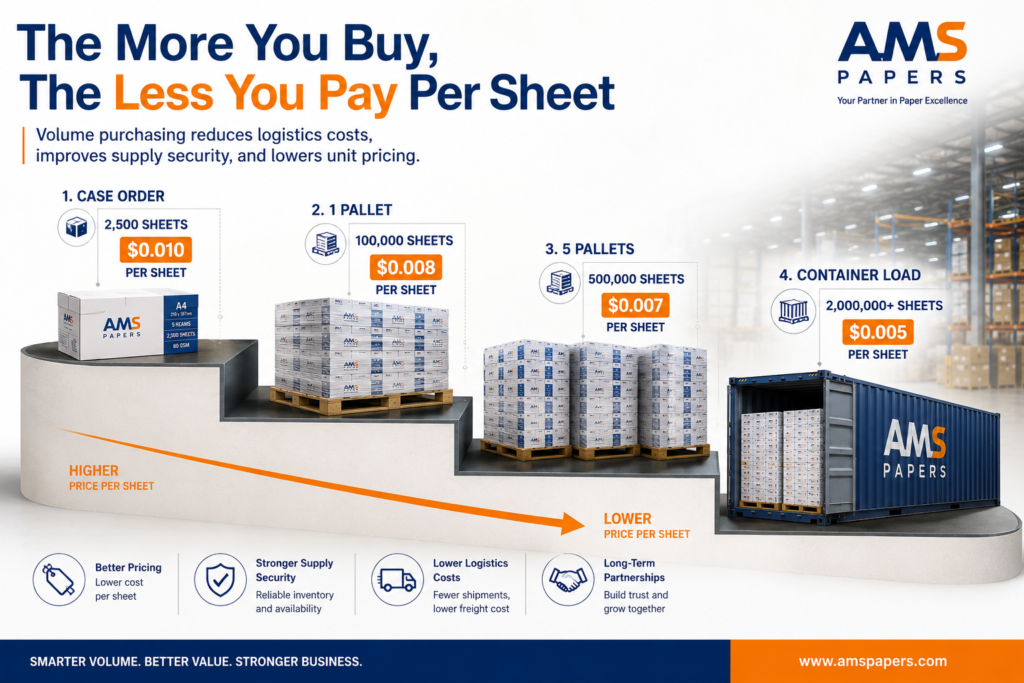
Pricing tiers are the mechanism suppliers use to reward larger orders without having to negotiate every single quote individually. Instead of one flat wholesale price, most paper suppliers structure pricing in bands cross a volume threshold, and your entire order (not just the units above the threshold) is priced at the next tier down.
A simplified example of how this typically looks:
| Order Volume | Price Tier | Approximate Discount vs. Retail |
|---|---|---|
| 1–9 cases | Standard/Retail | Baseline |
| 10–39 cases | Tier 1 (Entry Wholesale) | 8–12% |
| 40–99 cases | Tier 2 (Volume Wholesale) | 15–20% |
| 100+ cases / pallet+ | Tier 3 (Bulk Wholesale) | 20–30%+ |
These percentages are illustrative, not universal actual tier structures vary meaningfully by supplier, region, and product category, and should always be confirmed directly rather than assumed from a generic chart like this one.
What Else Affects Pricing Beyond Volume
Volume is the headline factor, but several other variables shift where you land within a given tier:
- Payment terms suppliers often offer better pricing for upfront payment or shorter payment terms versus extended net-30/net-60 credit
- Order consistency a recurring, predictable order schedule is worth more to a supplier than a one-off bulk order of the same size, and pricing sometimes reflects that
- Mixed vs. single-SKU pallets ordering multiple products on one pallet is sometimes priced slightly higher than a single-SKU full pallet, since it complicates the supplier’s picking process
- Freight terms whether the buyer or supplier arranges shipping affects the final landed cost, separate from the unit price itself
When Does Buying Wholesale Paper Make Sense?
Wholesale paper makes financial sense when three conditions are met together, not just one:
- Your consumption is predictable enough to commit to volume wholesale pricing rewards commitment, and ordering more than you’ll reliably use just to hit a price tier often erases the savings through waste or storage problems.
- You have adequate, appropriate storage the pricing advantage of wholesale paper assumes the product is stored correctly until used; paper that degrades from poor storage before it’s consumed negates the savings entirely.
- The order size doesn’t outrun your cash flow a lower per-unit price still requires more capital tied up in inventory upfront, which needs to make sense against your actual cash position, not just the unit economics.
A Practical Example
A mid-sized office consuming roughly 40 reams of copy paper a month is a reasonable candidate for entry-level wholesale pricing (Tier 1 in the example above) if they can commit to a recurring order and have basic dry storage space. That same business jumping to a full-pallet, Tier 3 order to chase a bigger discount without the storage or usage rate to support it often ends up with paper sitting in suboptimal conditions for months, quietly losing the quality (and the printer performance) the lower price was supposed to protect.
When Wholesale Doesn’t Make Sense
- Inconsistent or low-volume printing needs the savings rarely outweigh the storage and cash-flow trade-offs
- Limited or uncontrolled storage conditions humidity, temperature swings, or space constraints that risk paper quality before it’s used. See our Paper Shelf Life Guide for what actually degrades stored paper and how long it realistically lasts.
- Frequently changing paper specifications businesses that switch GSM, brightness, or brand often are poorly suited to large, single-SKU commitments
Common Mistakes Businesses Make When Buying Wholesale Paper
Chasing the next pricing tier without the consumption to support it. The math only works if the paper actually gets used before quality degrades buying past your real usage rate to hit a discount threshold is a false economy.
Assuming “wholesale” always means genuinely better pricing. Some suppliers apply the wholesale label loosely to what is really just a modest bulk discount; comparing actual per-unit cost against a true market-rate wholesale quote is the only way to know.
Ignoring storage requirements when sizing an order. As covered above, this is one of the most common ways wholesale savings quietly evaporate.
Not asking about MOQ flexibility before committing. Many suppliers have more flexibility on MOQs than their published pricing suggests, particularly for a recurring order relationship rather than a one-off purchase.
Overlooking freight and landed cost. A lower unit price with expensive or supplier-favorable freight terms can end up costing more overall than a slightly higher unit price with better shipping terms.
How to Choose the Right Wholesale Paper Supplier
Beyond price, a few specific things distinguish a supplier worth building a recurring wholesale relationship with:
- Transparent MOQ and tier structure a supplier who can clearly explain their actual thresholds, rather than a vague “contact us for wholesale pricing,” is signaling a more mature, honest pricing structure.
- Consistency across orders the same GSM, brightness, and quality batch to batch matters more at wholesale volume, since inconsistency compounds across a much larger order. Our US Paper Weight vs GSM Guide covers how to verify these specifications match what you’re actually being quoted.
- Flexible order structuring the ability to mix products on a pallet, adjust order cadence, or step between tiers as your consumption changes, rather than a rigid single-tier-or-nothing structure.
- Clear disclosure on branded vs. private-label stock particularly relevant when comparing wholesale quotes across suppliers, since two “wholesale” quotes for what looks like the same product may not actually be the same product.
Working with a [Internal Link: Copy Paper Supplier] that can answer MOQ and tier questions clearly and consistently rather than treating pricing as a black box is one of the more reliable signals of a supplier worth a long-term wholesale relationship.
Frequently Asked Questions
What does wholesale paper mean? Wholesale paper refers to paper sold in bulk quantities typically by the case, pallet, or container at a lower per-unit cost than retail pricing, usually structured for business buyers rather than individual consumers.
What is MOQ in wholesale paper? MOQ (minimum order quantity) is the smallest quantity a supplier will sell in a single order at wholesale pricing, commonly set at the case, pallet, or container level depending on the paper category and supplier.
How do wholesale paper pricing tiers work? Pricing tiers apply a lower per-unit price once an order crosses a volume threshold the entire order is priced at the new tier, not just the units above the threshold, rewarding larger and more consistent purchasing.
When does buying wholesale paper make sense for a business? It makes sense when consumption is predictable enough to commit to volume, storage conditions are adequate to protect paper quality until use, and the order size doesn’t strain cash flow relative to the savings gained.
Is wholesale paper always cheaper than retail? Not automatically the label “wholesale” doesn’t guarantee genuine savings. Comparing actual per-unit landed cost (including freight) against a true market-rate wholesale quote is the only reliable way to confirm real savings.
Can small businesses access wholesale paper pricing? Yes, though typically at entry-level tiers (case-level MOQs) rather than pallet or container thresholds; many suppliers offer a lower first tier specifically to accommodate smaller, recurring business buyers.
Does buying in bulk affect paper quality or shelf life? Not by itself quality and shelf life depend on storage conditions after purchase, not order size. Bulk buying only becomes a quality risk when storage capacity or conditions can’t properly support the volume purchased.
How do I know if a supplier’s MOQ is negotiable? Ask directly, particularly if you’re proposing a recurring order relationship rather than a one-off purchase many suppliers have more flexibility on MOQs for consistent, long-term buyers than their published thresholds suggest.
What’s the difference between a case, pallet, and container MOQ? A case is a small bundle of reams; a pallet is many cases stacked and shrink-wrapped together for shipping; a container is a full shipping container’s worth, typically reserved for the largest distributor-level orders.
Should a business negotiate freight terms separately from unit price? Yes freight and landed cost can meaningfully change the real cost advantage of a wholesale quote, and negotiating them separately from the per-unit price often reveals savings (or hidden costs) that the headline price alone doesn’t show.